
Patient access, triage, and agents
Sully.ai
Healthcare AI-agent platform and documentation API that describes agents for scribing, reception, triage, coding, nursing, interpretation, research, and EHR-connected workflows.
Last updated: June 14, 2026
Back to directoryAI cancer-detection and clinical decision-support platform that helps clinicians and patients identify cancer risk, choose referral pathways, and surface high-risk patients from records.

Organizations evaluating governed cancer-risk and early-detection workflows that must connect symptoms, risk factors, EHR data, patient self-assessment, referral pathways, and local service capacity.
Compare within workflow: Patient access, triage, and agents · comparison shortlist · source index
| Status | Vendor-stated UKCA Class I medical device and MHRA-regulated tool; verify current certificate, intended use, and jurisdiction-specific requirements. |
|---|---|
| Review route | UKCA Class I / MHRA medical-device positioning, with NHS clinical-risk and data-security compliance claims from vendor materials. |
| Intended use | Supports healthcare professionals and commissioned services with cancer-risk assessment, pathway guidance, patient self-assessment, and population-level early-detection workflows. |
| Verification note | Confirm the current UKCA/MHRA documentation, DCB0129/060 clinical safety case, local pathway configuration, EHR integration, patient self-assessment claims, and any US or non-UK regulatory status before clinical reliance. |
| Source | www.cthesigns.com / what-we-do |
Product-specific review. These product-specific signals summarize what the cited sources imply before treating C the Signs as safe for a local clinical, operational, or research workflow.
| Regulatory / FDA | Treat as high-risk clinical decision support and cancer-pathway software; verify UKCA Class I, MHRA-regulated status, NHS clinical-risk files, intended users, patient self-assessment boundaries, and any non-UK regulatory pathway before deployment. |
|---|---|
| Privacy | Review controller/processor roles, GP or provider data agreements, NHS number use, EHR record access, coded writeback, UK hosting, self-assessment flows, retention, subprocessors, cross-border transfers, and patient-facing consent. |
| Evidence | Use the official research trail as a starting point, then validate sensitivity, tumour-origin prediction, referral burden, stage shift, equity effects, and missed-cancer review against local cancer pathways and population mix. |
| Workflow | Define when the platform runs during consultation, self-assessment, or population scanning; who reviews outputs; how referrals are made; how false positives or missed cases are audited; and how pathway updates are governed. |
C the Signs describes an AI platform for early cancer detection that uses more than 1,000 validated data points, supports clinician risk assessment and referral in under 60 seconds, integrates with NHS EHRs, scans population records, and provides patient self-assessment. Vendor pages state UKCA Class I medical-device status, NHS clinical-risk and data-security compliance, HIPAA/HITECH positioning, and research pages summarizing real-world cancer-detection studies.
Not for: Standalone cancer diagnosis, emergency triage, consumer use without commissioned pathways, or replacing clinician judgment, specialist referral criteria, diagnostic testing, and local cancer governance.
Use these links to confirm current claims, terms, regulatory status, pricing, and deployment requirements.
Healthcare AI-agent platform and documentation API that describes agents for scribing, reception, triage, coding, nursing, interpretation, research, and EHR-connected workflows.
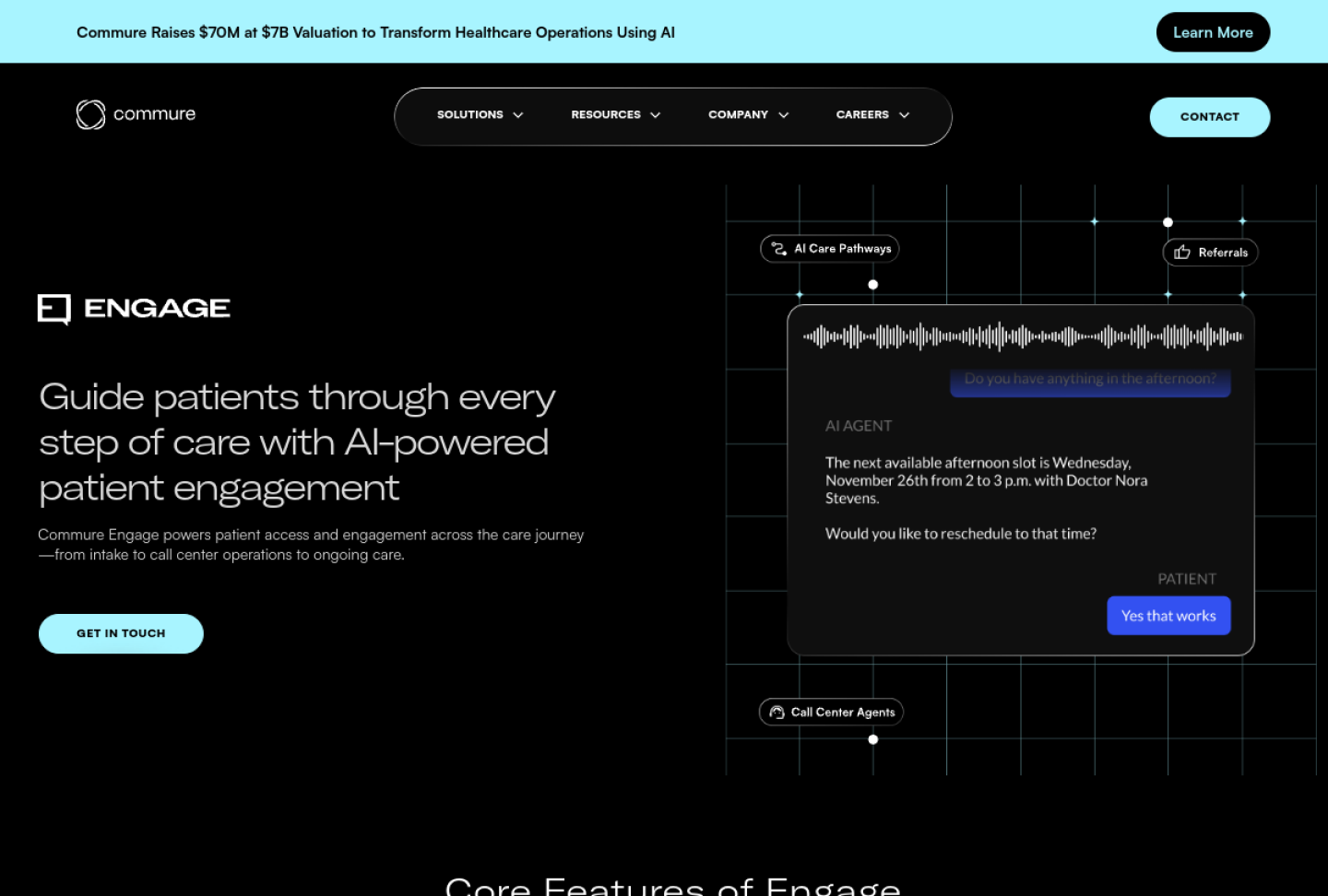
Intelligent care enablement platform for automating patient touchpoints and supporting care teams across longitudinal care journeys.
Clinical AI symptom-assessment and care-navigation platform for digital front door and patient-routing workflows.
Digital triage and AI medical-assistant platform for patient guidance, care routing, and healthcare-organization workflows.