Patient access, triage, and agents
Canary Speech
Voice biomarker platform that analyzes speech to generate behavioral and cognitive decision-support signals for clinicians, payers, call centers, and research workflows.
Last updated: June 13, 2026
Back to directoryCare access platform with Hybrid AI, symptom checking, conversational intake, triage and routing, provider navigation, virtual care workflows, and enterprise security controls.
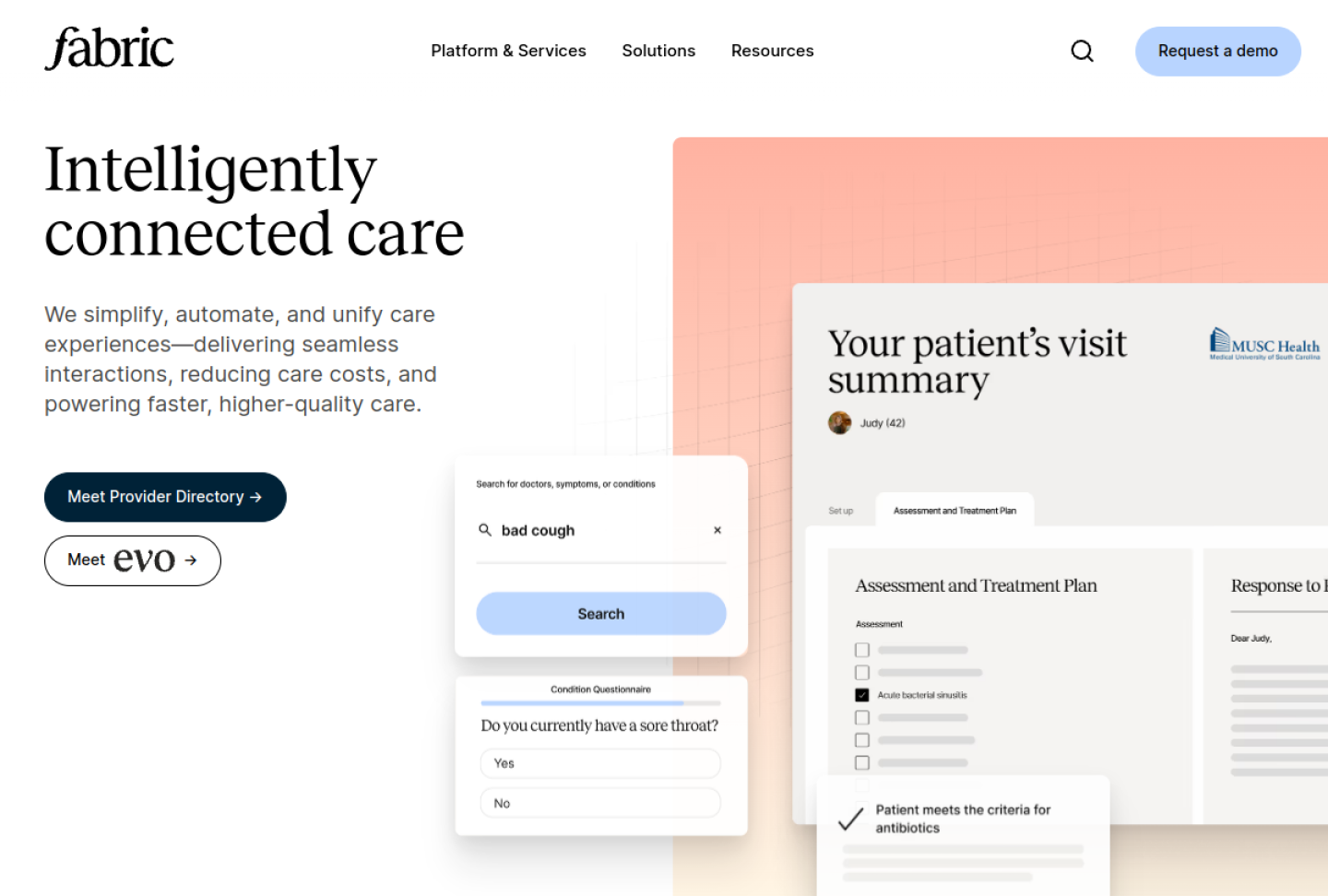
Organizations that want one patient-access layer for symptom collection, routing, virtual or in-person care navigation, scheduling, provider directory workflows, and clinical-network handoff.
Compare within workflow: Patient access, triage, and agents · comparison shortlist · source index
Product-specific review. These product-specific signals summarize what the cited sources imply before treating Fabric Health as safe for a local clinical, operational, or research workflow.
| Regulatory / FDA | Treat as patient-facing triage, navigation, and clinical workflow support; verify intended use, jurisdiction, clinical protocol ownership, physician-built logic, escalation language, and whether any configured workflow creates regulated clinical decision-support obligations. |
|---|---|
| Privacy | Review customer-specific BAA, PHI handling, patient-facing notices, EMR integration permissions, chat and symptom-data retention, support access, access controls, deletion, subprocessors, and how website versus patient-solution privacy terms differ. |
| Evidence | Use official case studies and vendor performance claims only as diligence inputs; run local validation for triage dispositions, urgent escalation, routing completeness, patient completion, call-center deflection, and subgroup performance. |
| Workflow | Best governed as a digital front door with explicit endpoint maps, emergency scripts, live escalation, care-team queue ownership, clinical-quality review, analytics monitoring, and periodic audit of unexpected routing patterns. |
Fabric describes a care access platform with an AI Assistant, symptom checking, navigation, triage and routing, provider directory, virtual care, and engagement workflows. Its Hybrid AI materials say the platform combines advanced conversational AI with physician-built clinical logic, while symptom-checker pages describe natural-language chat, disposition identification, SNOMED codes, and routing to virtual or in-person care. Public security and privacy pages describe SOC 2 Type 2, HIPAA-oriented controls, WCAG 2.1, EMR integrations, and business-associate handling of PHI for healthcare-organization customers.
Not for: Standalone emergency triage, autonomous diagnosis or treatment advice, unsupported clinical protocols, or deployments without local endpoint mapping, escalation, consent, privacy, and clinical-quality review.
Use these links to confirm current claims, terms, regulatory status, pricing, and deployment requirements.
Voice biomarker platform that analyzes speech to generate behavioral and cognitive decision-support signals for clinicians, payers, call centers, and research workflows.

Voice AI platform that analyzes speech signals to support behavioral-health screening, symptom-severity measurement, and care-management prioritization.
Agentic platform for building, running, and monitoring healthcare AI agents across voice, SMS, chat, web, and Epic-connected workflows.
Healthcare AI voice-agent platform for specialty patient access, inbound and outbound scheduling, routing, intake, and follow-up workflows.