
Clinical operations and revenue cycle
Azra AI
Oncology workflow automation platform that uses AI to turn unstructured pathology, radiology, clinical document, and EMR data into actionable patient-management worklists.
Last updated: June 12, 2026
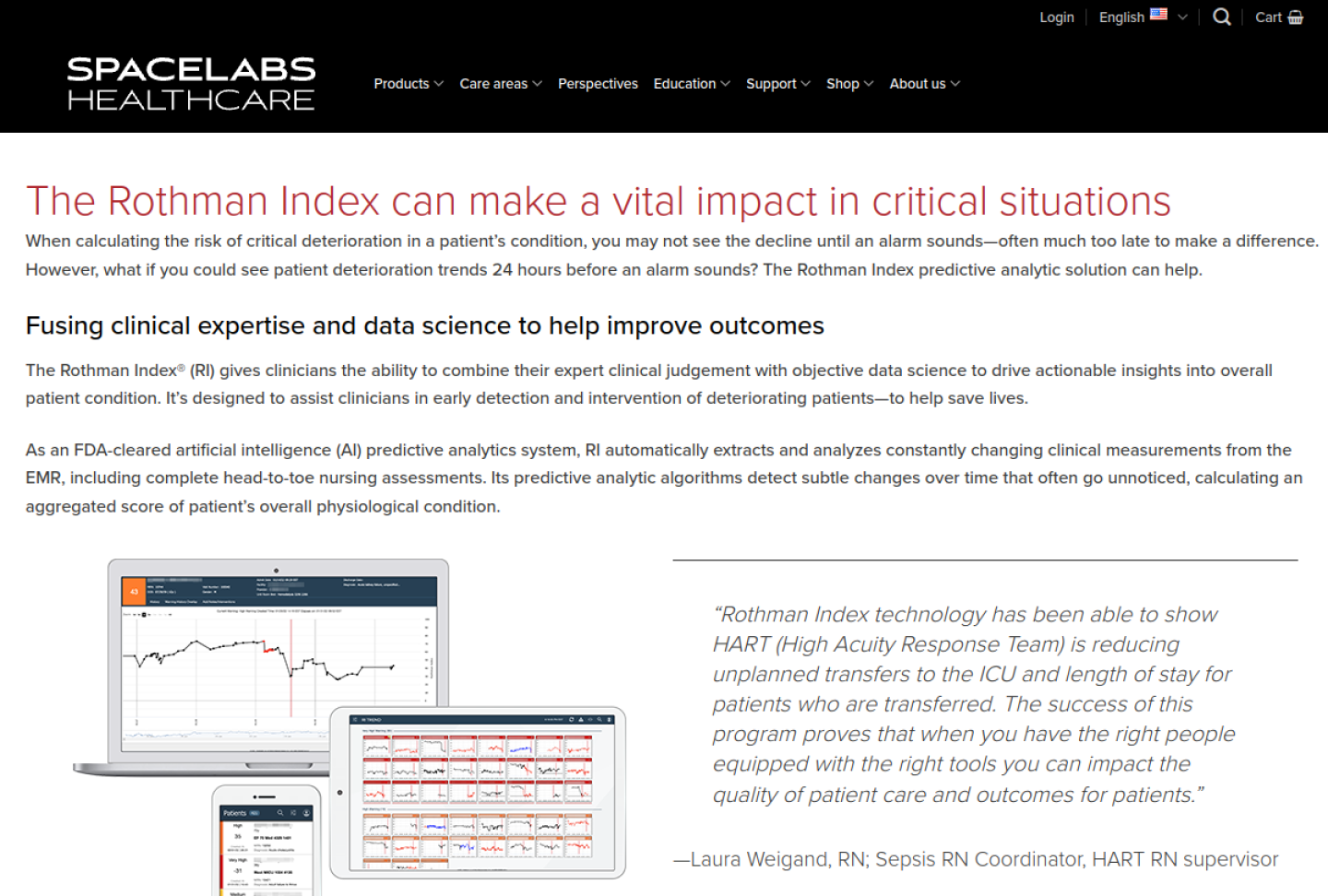
Back to directoryFDA-cleared patient surveillance and predictive analytics system that uses EHR-derived vital signs, labs, and nursing assessments to trend patient acuity through the Rothman Index.
Hospitals that need a governed inpatient deterioration signal across units, with clinician-owned escalation protocols and local monitoring of alert burden and outcomes.
Compare within workflow: Clinical operations and revenue cycle · comparison shortlist · source index
Product-specific review. These product-specific signals summarize what the cited sources imply before treating Spacelabs Rothman Index as safe for a local clinical, operational, or research workflow.
| Regulatory / FDA | Treat as regulated high-risk clinical decision-support and patient-surveillance software; match use to FDA 510(k) K172959, intended-use language, software version, care setting, warnings, and clinician-adjunct boundaries. |
|---|---|
| Privacy | Review contract-specific privacy and security terms because the workflow depends on EHR, lab, nursing-assessment, warning-state, dashboard, and integration data that may contain PHI and operationally sensitive information. |
| Evidence | Use FDA documentation, Spacelabs resources, peer-reviewed literature, and local silent-mode or supervised pilots to validate calibration, alert thresholds, response pathways, outcome impact, and subgroup performance. |
| Workflow | Best governed as hospital-wide early-warning infrastructure with explicit owners for score review, rapid-response routing, unit-level thresholds, clinician education, escalation, downtime, and post-deployment monitoring. |
Spacelabs describes the Rothman Index as an FDA-cleared AI predictive analytics system that automatically extracts and analyzes changing clinical measurements from the EMR, including nursing assessments, to calculate an aggregate view of patient physiological condition. FDA 510(k) K172959 describes PeraServer and PeraTrend as software that computes and displays Rothman Index scores, configurable warnings, and clinical data for adjunctive clinical decision support.
Not for: Autonomous diagnosis, treatment selection, replacing bedside assessment, unsupported patient populations or workflows, or deployment without EHR integration testing, clinician training, and response governance.
Use these links to confirm current claims, terms, regulatory status, pricing, and deployment requirements.
Oncology workflow automation platform that uses AI to turn unstructured pathology, radiology, clinical document, and EMR data into actionable patient-management worklists.
Referral optimization and patient activation platform that combines network intelligence, AI-driven prioritization, playbooks, scheduling activation, and outcomes attribution for health systems.

Ambient monitoring platform that gives care teams real-time room-level signals, alerts, fall-risk workflows, analytics, and AI answers from monitoring data.

Revenue cycle AI platform with coding and RCM agents that generate traceable codes, apply payer rules, support CDI, and route complex work to human review.