| ModelOp Center |
Organizations formalizing AI intake, model inventory, validation evidence, policy controls, and monitoring across many clinical, payer, or life-sciences AI use cases. |
Which inventories, controls, model cards, approval workflows, monitoring metrics, and evidence exports are included. |
2 official sources |
| Credo AI Platform |
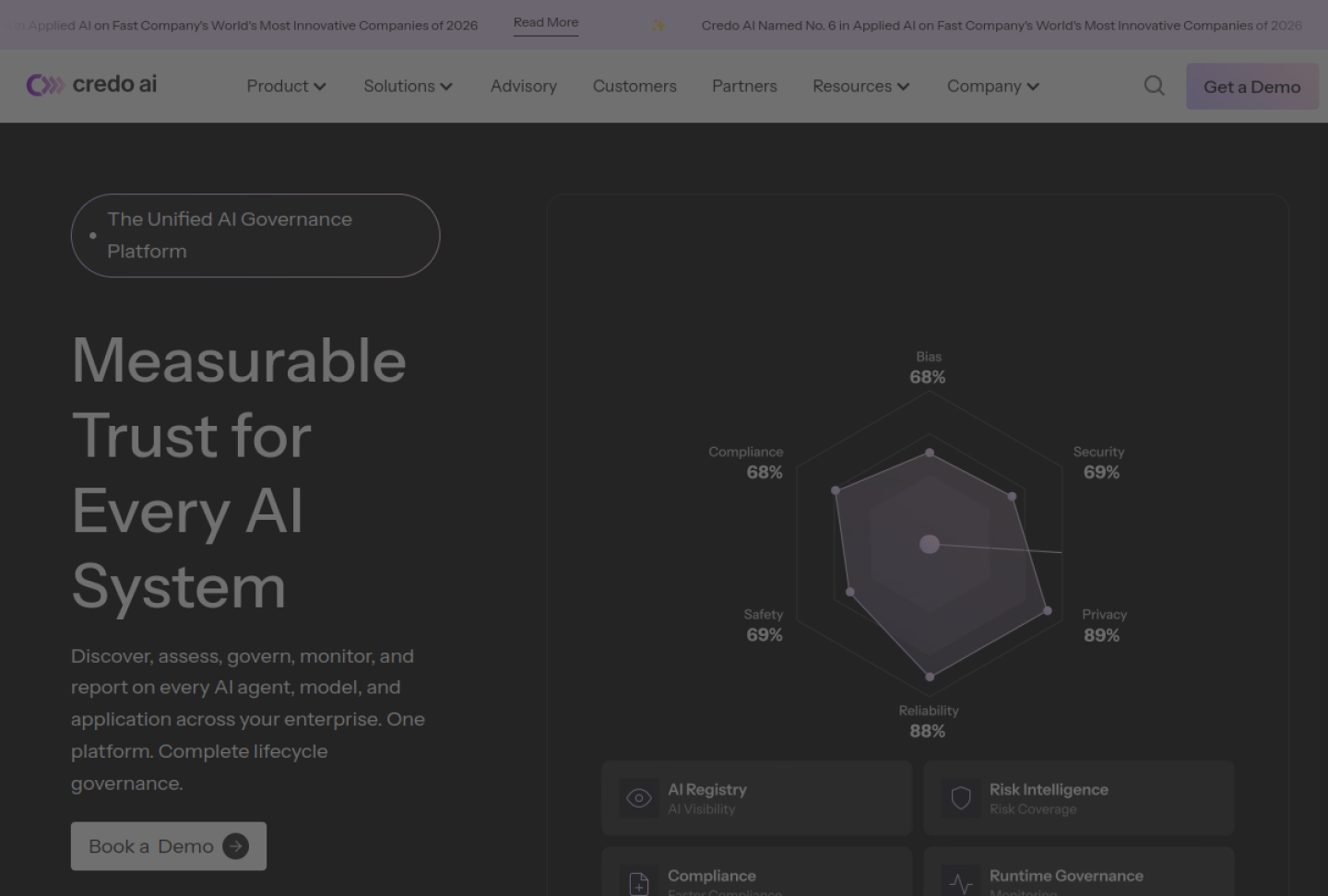
Teams that need a centralized AI registry and governance workflow spanning internally built models, third-party AI, agents, and regulated deployment contexts. |
Which modules are included: AI registry, vendor registry, policy packs, evaluations, evidence generation, agent governance, and integrations. |
3 official sources |
| Mendel Redact |
Organizations preparing unstructured clinical records for research, real-world evidence, analytics, or partner sharing where PHI masking must be measured and auditable. |
Which Mendel modules are in scope, including Redact, Retina OCR, clinical NLU, source-evidence extraction, or broader clinical-data structuring workflows. |
4 official sources |
| Fiddler AI Observability |
Teams that already have AI models or agents in production and need runtime visibility, guardrails, drift monitoring, investigation workflows, and evidence for oversight. |
Which model, LLM, agent, prompt, trace, feature, drift, hallucination, PHI, fairness, and guardrail metrics are supported. |
3 official sources |
| Arize AI Observability |
Technical healthcare teams that need traces, evaluations, monitoring, and debugging for custom AI systems or agentic workflows. |
Which Arize, Phoenix, AX, tracing, evaluation, prompt, drift, and monitoring features fit the deployed AI workflow. |
2 official sources |
| Monitaur |
Insurance, payer, and regulated-enterprise teams that need repeatable model governance, validation evidence, performance monitoring, and compliance reporting. |
Which governance workflows cover AI inventory, model performance, validation, compliance, documentation, and reporting. |
2 official sources |
| Saidot |
Organizations with European AI deployments that need structured AI system records, EU AI Act-oriented controls, and shared governance evidence. |
Whether Saidot covers the healthcare use case, EU AI Act role, risk category, deployment country, and internal governance workflow. |
2 official sources |
| Chryso.ai |
Health systems or regulated healthcare teams that need a structured control-evidence layer around AI inventory, staff training, audits, and monitored agent behavior. |
Which frameworks, controls, policy templates, evidence workflows, and AI-agent monitoring features are active for your deployment. |
2 official sources |
| ALIGNMT AI |
Healthcare organizations that need a mix of governance software, healthcare AI risk expertise, real-world monitoring, and assessment support before or after production deployment. |
Which modules are included: governance, assessment, mitigation, report cards, advisory services, data assets, or continuous monitoring. |
4 official sources |
| Risk Meridian |
Teams that need a lightweight AI risk register and governance-document workflow for healthcare, enterprise, or regulated AI systems before auditors or boards ask for evidence. |
Which healthcare-specific fields, risk tiers, control mappings, incident logs, disclosure templates, and board reports are available in your plan. |
5 official sources |
| Censinet RiskOps AI Governance |
Health systems that already treat AI governance as a cross-functional risk program and need vendor, enterprise, systemic, and AI risk workflows in one healthcare-specific platform. |
Which modules are live in the contracted scope: RiskOps, AI Governance, TPRM AI, ERM AI, benchmarking, GRC AI agents, or systemic-risk workflows. |
4 official sources |
| Trase OS |
Healthcare organizations piloting or scaling AI agents for administrative and clinical-operations workflows that need policy enforcement, human escalation, and auditability before production. |
Which agent workflows are included, such as fax routing, referral triage, clinical summarization, prior authorization, lab result interpretation, compliance audit, or medication reconciliation. |
4 official sources |
| ShadowIQ for Healthcare |
Healthcare teams that need a control layer around clinician copilots, payer AI workflows, or health-tech SaaS features before prompts, PHI, and model outputs reach approved AI providers. |
Which workflows are routed through ShadowIQ: clinician copilots, payer review, internal assistants, patient-facing tools, or health-tech SaaS features. |
6 official sources |
| Harness.health |
Health systems that need a practical AI inventory with ownership, risk classification, quality metrics, safety events, and compliance reporting around deployed tools. |
Which AI tools, departments, contracts, owners, risk tiers, and live metrics the registry can track. |
3 official sources |
| SAIGE |
Healthcare organizations that want a centralized AI registry and risk-monitoring workflow for scaling AI oversight across many internal and vendor systems. |
Which AI inventory fields, registration workflows, risk scoring, policy mappings, and vendor collaboration features are configured. |
3 official sources |
| Grid Health |
Health systems that need practical visibility into deployed vendor, EHR-embedded, or internal AI tools before expanding or renewing AI programs. |
Which AI systems, vendor tools, EHR-embedded models, internal models, workflows, users, and cost data Grid can observe. |
3 official sources |
| Asher Informatics |
Healthcare organizations that need governance controls and independent oversight for bought or built AI tools across imaging, signal, text, clinical, operational, and administrative use cases. |
Which AshMatics Suite capabilities are included, such as governance studio, monitoring studio, service-line SOP controls, regulatory tracking, and operational utility modeling. |
2 official sources |
| Integral Privacy Engine |
Organizations that need stronger privacy review and documentation before moving real-world health data into AI training, analytics, clean rooms, or partner data products. |
Whether the engagement uses Expert Determination, Remediation Preview, Compliant Pipeline, deployment tooling, or a forward-deployed privacy program. |
5 official sources |
| Cognome ExplainerAI |
Organizations with deployed predictive models or shadow-AI risk that need model transparency, inventory, monitoring, and governance evidence connected to healthcare systems. |
Which ExplainerAI and AI Sniffer capabilities are in scope, including model explainability, monitoring, inventory, endpoint discovery, or public-LLM usage detection. |
4 official sources |
| Qualified Health |
Health systems that want a governed platform for scaling multiple AI use cases across clinical, operational, financial, and administrative workflows instead of managing many disconnected pilots. |
Which platform capabilities and deployed solutions are in scope, including Qualified Chat, builder tools, pre-built workflows, data integration, governance dashboards, education, and outcomes tracking. |
5 official sources |