Last updated: June 14, 2026
Back to directory
Microsoft Healthcare Agent Service medical AI product profile
Microsoft Azure service for building compliant healthcare agents and copilots across patient access, healthcare intelligence, scheduling, and source-grounded support workflows.
Patient access, triage, and agents
Best fit
Microsoft-centered healthcare teams that need a configurable healthcare chatbot or copilot layer with Azure identity, security, integration, and monitoring controls.
- Primary use case
- Azure-based healthcare agent service for symptom-checker, triage, generative answers, scheduling, healthcare intelligence, and integration with customer data sources
- Audience
- Healthcare organizations, digital front door teams, developers, access centers, and Microsoft Azure customers building patient or staff-facing healthcare copilots
- Risk level
- Medium to high
- Pricing signal
- Azure and healthcare agent service pricing can vary by tenant, region, connected Azure services, messages, integrations, and support plan; verify current Microsoft terms.
- Official sources
- 4 official sources
Compare within workflow: Patient access, triage, and agents · comparison shortlist · source index
Regulatory, privacy, evidence, and workflow lens
Product-specific review. These product-specific signals summarize what the cited sources imply before treating Microsoft Healthcare Agent Service as safe for a local clinical, operational, or research workflow.
| Regulatory / FDA | Treat as configurable healthcare agent infrastructure until the exact scenario is known. Reassess risk when the agent handles symptom triage, patient-specific clinical information, care-routing decisions, medical knowledge, or integrations that can affect access to care. |
|---|
| Privacy | Verify Microsoft BAA coverage, HIPAA-eligible service scope, Azure tenant settings, data residency, transcript retention, Azure OpenAI data handling, authentication, connected data sources, and downstream integrations for the exact bot. |
|---|
| Evidence | Validate answers against approved sources, medical protocols, customer content, and escalation rules. Test source citation quality, language support, hallucinations, stale content, unsafe reassurance, and staff handoff quality before patient-facing launch. |
|---|
| Workflow | Best governed as a configurable digital front door or staff copilot with named intents, allowed data sources, explicit emergency routing, human escalation, monitoring, and change-control review. |
|---|
Where Microsoft Healthcare Agent Service fits
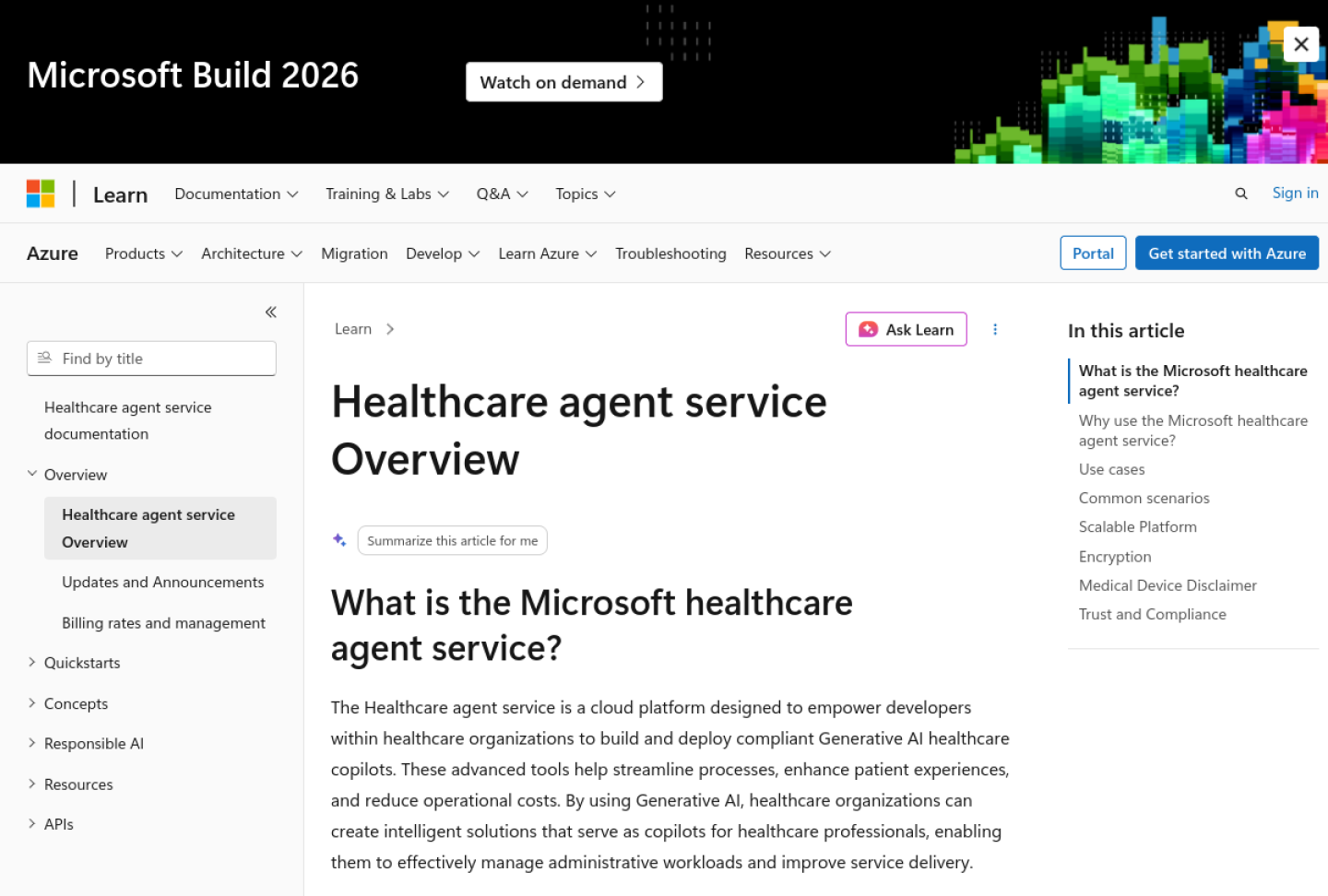
Microsoft Learn describes the Healthcare Agent Service as an Azure cloud platform for healthcare organizations to build and deploy compliant generative AI healthcare copilots. The documentation lists scenarios including symptom checker and triage, generative answers on customer sources, Healthcare Intelligence, scheduling, and integrations with EMR, health information, customer systems, websites, chat channels, and digital assistants. Microsoft compliance materials say customers should verify BAA and HIPAA-covered-service requirements for the services they use.
Not for: Unsupervised diagnosis, emergency triage without escalation, autonomous medication or treatment decisions, or deployments where source grounding, PHI handling, and human review are undefined.
What to verify before using Microsoft Healthcare Agent Service
- Which scenario is enabled: symptom checker, triage, generative answers on customer sources, Healthcare Intelligence, scheduling, staff copilot, or a custom OpenAPI plugin.
- Whether the deployment uses Healthcare Agent Service, Azure OpenAI, Copilot Studio, Healthcare API, customer source data connections, or other Azure services, because each affects data flow and cost.
- BAA status, HIPAA-covered service scope, tenant configuration, identity controls, audit logs, chat transcript retention, prompt and output storage, and connected system permissions before PHI is processed.
- How the bot handles urgent symptoms, unclear answers, source citation gaps, patient identity, scheduling errors, integration failures, and handoff to staff or clinicians.
- Local validation plan for medical protocol fit, language quality, escalation accuracy, unsafe reassurance, hallucinated answers, source alignment, and monitoring after launch.
Source links
Use these links to confirm current claims, terms, regulatory status, pricing, and deployment requirements.
Related medical AI products