Evaluate obstetrics and fetal monitoring AI by FDA status, gestational-age scope, clinician review, privacy, alerts, and maternal-fetal workflow risk.
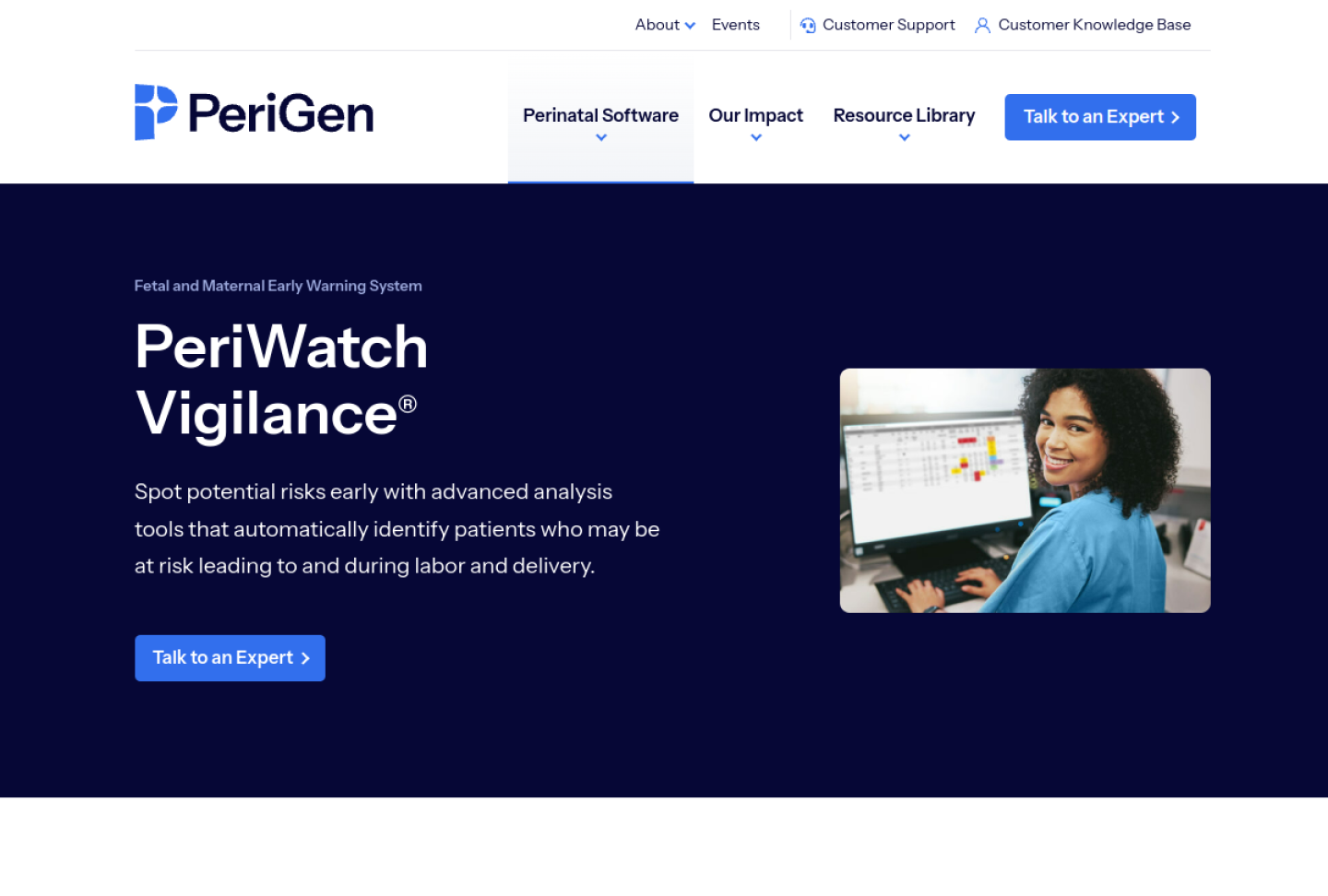
Representative source image: official PeriGen PeriWatch Vigilance product page.
Quick answer: Obstetrics and fetal monitoring AI should be evaluated as high-risk clinical workflow or medical-device software. Match each product to its FDA or local status, gestational-age and pregnancy scope, signal or image inputs, clinician-review boundary, privacy terms, and local escalation protocol before using outputs in maternal-fetal care.
Who this guide is for
OB/GYN leaders, maternal-fetal medicine teams, labor and delivery units, perinatal safety committees, virtual care teams, and health-system AI governance groups.
What makes this workflow different
Perinatal AI can influence fetal surveillance, ultrasound acquisition, non-stress testing, command-center alerting, and maternal-fetal escalation, so buyers need device-specific diligence rather than broad remote-monitoring claims.
What to verify before using it
Confirm the exact intended use, FDA 510(k), CE or local status, gestational-age range, singleton or multiple-pregnancy scope, and whether the tool supports ultrasound, fetal heart rate, uterine activity, or command-center surveillance.
Map fetal tracings, maternal vitals, ultrasound images, clips, patient app data, EMR interfaces, cloud processing, mobile notifications, PHI retention, support access, and audit logs.
Define who reviews findings, alerts, non-stress tests, quality checks, and escalation signals before patient-management decisions are made.
Validate performance locally for monitor quality, scanner fleet, maternal BMI, gestational age, preterm cases, alert burden, false reassurance, missed deterioration, and equity across patient groups.
Create downtime, patient-instruction, after-hours, emergency, and incident-review procedures so families and staff understand when AI-supported monitoring is active and what it does not replace.
Risk level and safe use
Medical risk
High
Best first step
Write the workflow in one sentence, decide who reviews the AI output, and test with a small controlled pilot before expanding.
Recommended posture
Use AI as supervised workflow support. Verify sources, privacy, human review, and regulatory fit before relying on outputs.
Source-backed products for this workflow
These profiles are not rankings. They are starting points for checking vendor claims, privacy terms, FDA or regulatory posture, evidence, and workflow fit.
PeriGen describes PeriWatch Vigilance as an automated early warning and clinical decision-support system for labor and delivery that monitors maternal vital signs, fetal heart rate patterns, contractions, and labor progress. PeriGen says Vigilance uses supervised machine learning for fetal heart rate pattern interpretation and contraction detection and incorporates FDA-cleared algorithms. FDA 510(k) K241009 identifies PeriCALM Patterns 3.0 as Class II perinatal monitoring software for adjunctive antepartum or intrapartum obstetrical monitoring at or beyond 32 weeks gestation, with warnings that patient management should not be based solely on the software's annotations or summaries.
Best for
Hospital L&D programs that need continuous maternal-fetal surveillance, standardized alerting, and command-center visibility while keeping bedside assessment and patient-management decisions clinician-led.
First check
Whether the deployed module uses PeriCALM Patterns 3.0, PeriWatch Vigilance, Surveillance, mobile access, command-center workflows, or quality reports, and which parts are FDA-cleared versus workflow software.
Nuvo describes INVU as an AI-powered maternal-fetal remote monitoring platform that uses wearable sensors and cloud-based processing for fetal heart rate, maternal heart rate, and uterine activity monitoring. FDA 510(k) summaries K210025 and K221046 describe INVU by Nuvo as a Class II home uterine activity monitor for pregnant women at 32 weeks gestation or later with singleton pregnancy, ordered by a physician for antepartum fetal surveillance, and state that it does not prevent preterm labor or preterm birth.
Best for
Programs that need a governed way to extend maternal-fetal surveillance outside the clinic while keeping ordering, review, interpretation, and escalation under clinician-controlled protocols.
First check
Whether the deployed INVU workflow matches the current FDA-cleared indication, including gestational age, singleton pregnancy scope, antepartum fetal surveillance, home or facility use, prescription ordering, and software version.
Sonio describes Sonio Detect as an FDA 510(k)-cleared AI product for real-time fetal ultrasound view detection, anatomical-structure detection, and quality-criteria verification; FDA 510(k) summaries for K230365, K240406, and K252433 describe concurrent-reading-aid indications and version-specific validation and compatibility details.
Best for
Women's health teams that need real-time fetal ultrasound quality support while keeping acquisition, interpretation, reporting, and follow-up under qualified clinician governance.
First check
Which Sonio Detect version, Sonio Pro workflow, ultrasound manufacturer, country, and gestational-age range are in scope.
Validic describes Impact as turnkey remote care that lives inside the EHR, writes patient-generated health data to Epic, Cerner or other EHR workflows, supports device logistics and patient onboarding, and adds generative AI summaries for RPM trend review; Validic materials also describe HIPAA, HITRUST, ISO 27001, supported-device breadth, and processor/client data responsibilities that buyers should verify contractually.
Best for
Organizations standardizing remote patient monitoring or connected-device data across chronic-care, hospital-at-home, cardiology, diabetes, COPD, CHF, and value-based care programs.
First check
Which Validic workflow is in scope: Impact remote care, Inform API data infrastructure, HealthBridge patient experience, device logistics, value-based care, or EHR-embedded AI summaries.
Sources
7 official sources
Official source trail for this workflow
Open these vendor, documentation, privacy, or regulatory sources before relying on product claims, especially for FDA status, PHI handling, deployment model, and intended use.
Find the best AI for medical workflows by matching the tool to documentation, questions, diagnosis support, research, coding, billing, imaging, or practice operations.
Understand AI for medical diagnosis, including validation evidence, FDA status, clinical supervision, and why patient-specific diagnosis should not rely on general chatbots.