Oncology AI Tools: Precision Medicine and Trial Checks
Evaluate oncology AI tools by diagnostic status, molecular data flow, tumor board workflow, trial matching, privacy, evidence, and clinician oversight.
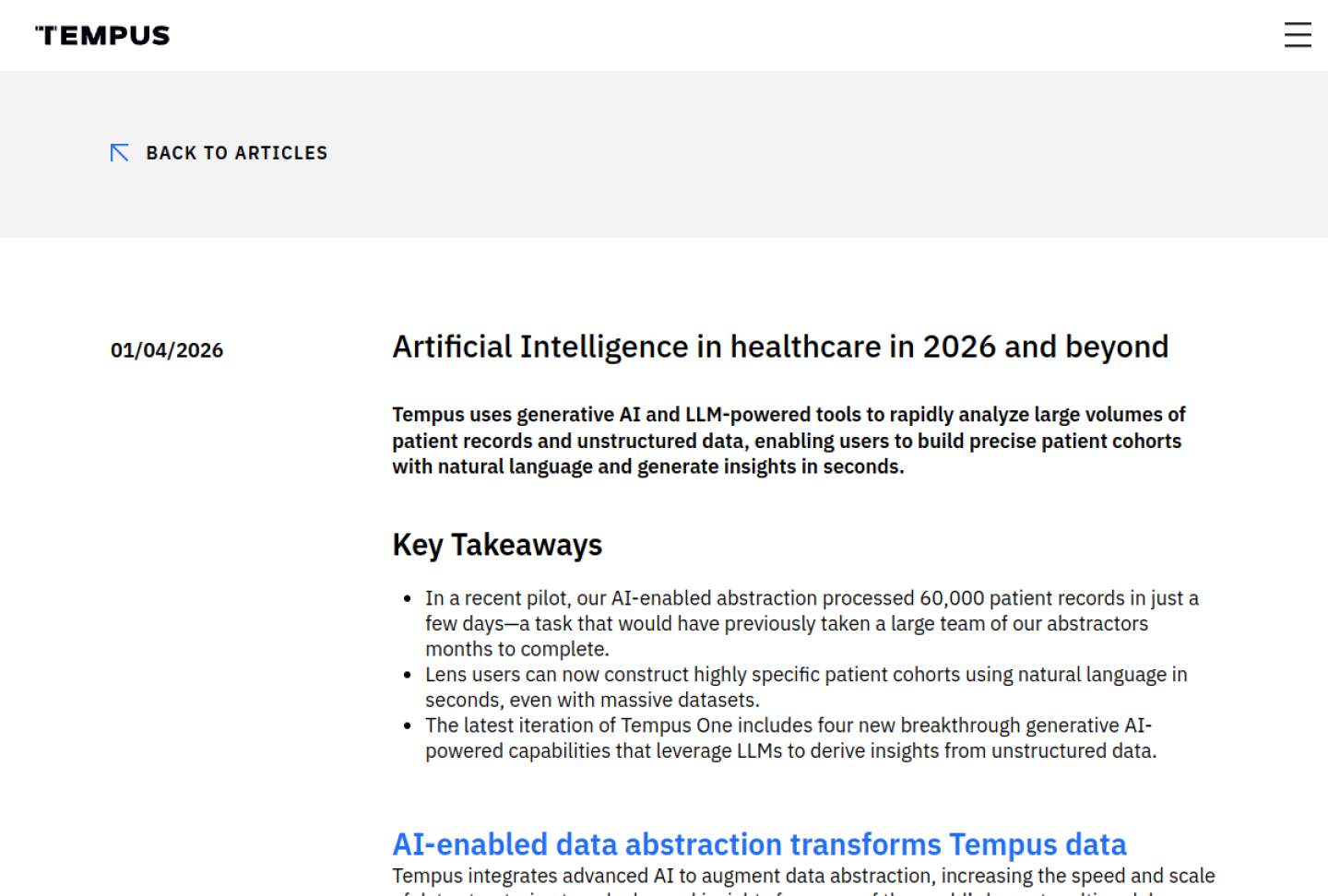
Representative source image: official Tempus product page.
Quick answer: Oncology AI tools should be evaluated by the exact workflow: molecular profiling, pathology review, prognosis, treatment-pathway support, real-world evidence, or clinical trial matching. Match each product to its intended use, source data, regulatory status, validation population, privacy terms, and tumor board or clinician review process before using outputs in care.
Who this guide is for
Oncology groups, tumor boards, molecular pathology teams, cancer centers, life-sciences teams, trial offices, and health-system AI governance committees.
What makes this workflow different
Oncology AI can influence diagnosis, prognosis, treatment planning, trial matching, and molecular interpretation, so buyers need product-specific evidence and human-review boundaries.
What to verify before using it
Separate molecular profiling, pathology image analysis, treatment-pathway support, prognosis, trial matching, and real-world evidence because each workflow has different risk.
Verify FDA, CLIA, lab-developed-test, CE-IVD, research-use, or local regulatory status for the exact product, disease area, specimen type, and intended use.
Map genomic, pathology, imaging, EHR, claims, trial, and real-world data flows before upload or integration.
Review validation populations, biomarker evidence, performance by cancer type, uncertainty handling, and whether evidence supports local patients and protocols.
Define tumor board, oncologist, pathologist, research nurse, or trial-team review before acting on recommendations, matches, or risk scores.
Risk level and safe use
Medical risk
High
Best first step
Write the workflow in one sentence, decide who reviews the AI output, and test with a small controlled pilot before expanding.
Recommended posture
Use AI as supervised workflow support. Verify sources, privacy, human review, and regulatory fit before relying on outputs.
Source-backed products for this workflow
These profiles are not rankings. They are starting points for checking vendor claims, privacy terms, FDA or regulatory posture, evidence, and workflow fit.
Azra AI describes enterprise solutions that identify, connect, and manage patients across clinical workflows, with oncology pages stating that the platform ingests pathology reports and clinical records in real time, identifies positive cancer diagnoses, structures cases by cancer type, and extracts details such as stage, grade, and tumor markers. Registry pages describe automated case finding with human-in-the-loop validation, and clinical-research pages describe EMR, notes, and PDF aggregation with traceable pre-screening citations. Elekta announced an April 2025 partnership combining Azra's real-time patient identification and workflow automation with Elekta ONE Registry Informatics for cancer registry operations.
Best for
Cancer programs that need real-time case finding, registry automation, navigation queues, tumor-board preparation, or clinical-trial pre-screening while preserving human review and oncology-team accountability.
First check
Which Azra workflow is in scope: oncology, registry automation, clinical trials, incidental findings, high-risk screening, multidisciplinary meetings, enterprise analytics, or embedded navigation services.
Tempus describes Tempus One as a generative AI-enabled assistant for healthcare providers and researchers that can surface patient insights from clinical and molecular data, support EHR workflows, summarize histories and biomarkers, search trials, and process unstructured multimodal data; Tempus announcements also describe EHR integration, guideline access, documentation support, and custom agent-building capabilities.
Best for
Oncology and precision-medicine teams that need governed access to Tempus patient insights, test status, guideline context, trial matching, and multimodal data summaries.
First check
Whether Tempus One is being used in Hub, an EHR integration, Lens, a provider workflow, or a life-sciences research workflow.
Tempus describes an AI-enabled precision medicine platform with Tempus One, Hub, Lens, Pixel, Next Pathways, Next Trials, assays, and algorithms; official technology and privacy pages should be checked for product-specific clinical, lab, data, and PHI boundaries.
Best for
Oncology and life-sciences teams evaluating AI-enabled precision medicine workflows that combine molecular, clinical, imaging, and real-world data.
First check
Which Tempus product is in scope: One, Hub, Now, Lens, Pixel, Next Pathways, Next Trials, assays, or algos.
Caris describes itself as a molecular science and AI company focused on precision medicine, and has announced Caris AI Insights signatures used in molecular tumor board reporting.
Best for
Oncology teams evaluating molecular profiling and AI-assisted insight workflows for cancer care and research.
First check
Which test, report, or AI insight is being used and its exact clinical role.
Sources
3 official sources
Official source trail for this workflow
Open these vendor, documentation, privacy, or regulatory sources before relying on product claims, especially for FDA status, PHI handling, deployment model, and intended use.
Find the best AI for medical workflows by matching the tool to documentation, questions, diagnosis support, research, coding, billing, imaging, or practice operations.
Understand AI for medical diagnosis, including validation evidence, FDA status, clinical supervision, and why patient-specific diagnosis should not rely on general chatbots.