Evaluate remote patient monitoring AI by devices, vitals, alert triage, clinician review, privacy, evidence, and care-at-home escalation workflow.
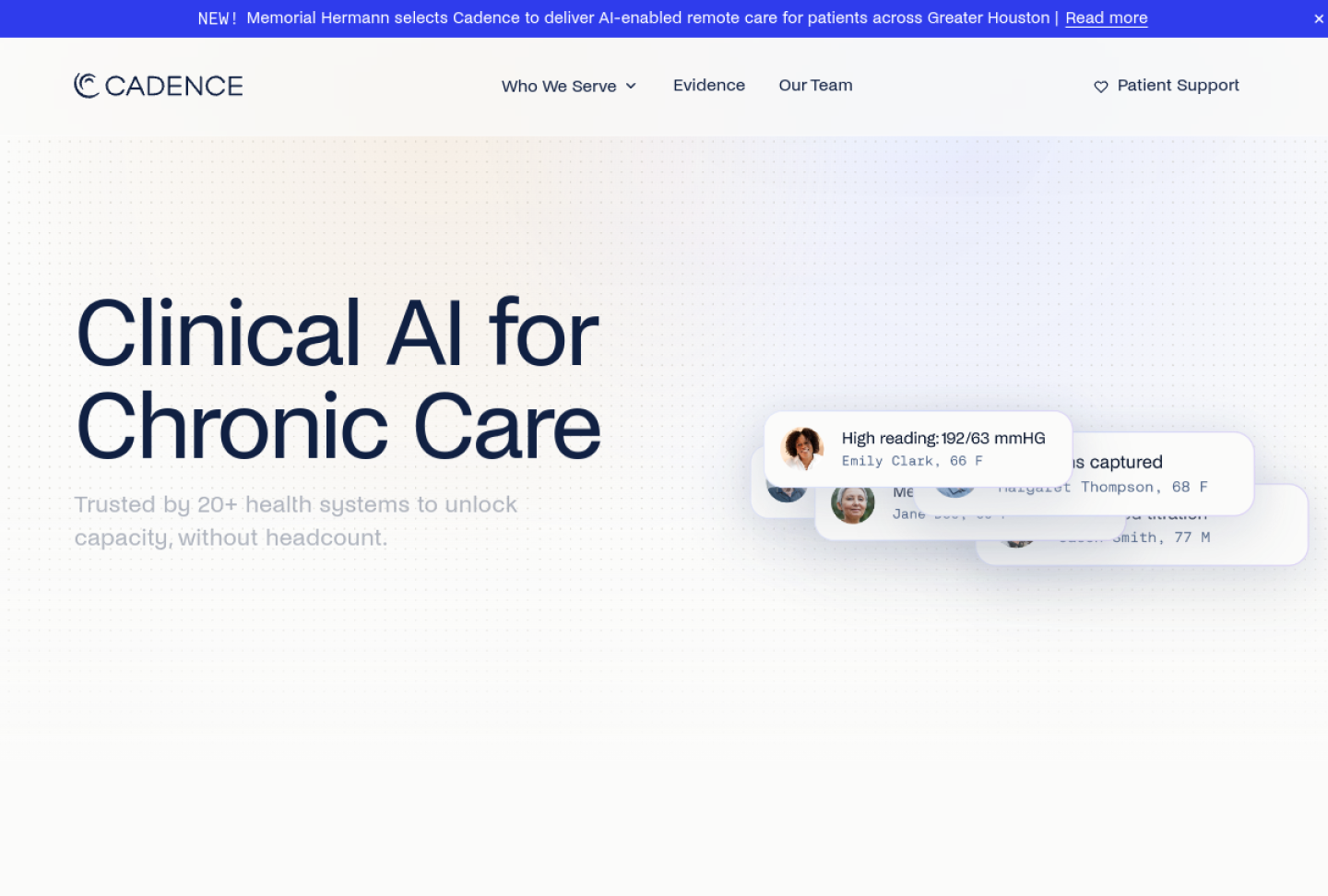
Representative source image: official Cadence Clinical Intelligence product page.
Quick answer: Remote patient monitoring AI can collect home vitals, surface risks, personalize baselines, support care-team outreach, and coordinate chronic or post-acute care. It should be deployed with clinician-reviewed alerts, patient consent, device support, privacy controls, escalation rules, and local monitoring for missed deterioration or alert fatigue.
Who this guide is for
Health systems, chronic-care programs, virtual care teams, home-hospital leaders, value-based care groups, and clinical operations teams evaluating AI-enabled remote monitoring.
What makes this workflow different
Remote monitoring AI becomes clinical operations infrastructure, so buyers need to verify devices, alert triage, escalation staffing, patient consent, and local outcome evidence before comparing vendors.
What to verify before using it
Define the monitored population, condition, device set, vitals, symptoms, alert thresholds, and who reviews each signal.
Verify whether AI outputs change triage, medication titration, escalation, billing, or clinical decision-making responsibilities.
Map device data, app data, questionnaires, EHR feeds, PHI, patient consent, BAA or customer terms, retention, support access, and home tech support.
Pilot for adherence, false alerts, missed deterioration, response time, clinician workload, patient experience, equity, utilization, and adverse events.
Create downtime and discharge-from-monitoring rules so patients and staff know when remote monitoring is active, paused, or no longer watched.
Risk level and safe use
Medical risk
Medium to high
Best first step
Write the workflow in one sentence, decide who reviews the AI output, and test with a small controlled pilot before expanding.
Recommended posture
Use AI as supervised workflow support. Verify sources, privacy, human review, and regulatory fit before relying on outputs.
Source-backed products for this workflow
These profiles are not rankings. They are starting points for checking vendor claims, privacy terms, FDA or regulatory posture, evidence, and workflow fit.
Welldoc describes its diabetes products as FDA-cleared digital health medical devices for adults with type 1 or type 2 diabetes, with AI-driven coaching, cardiometabolic support, multiple 510(k) clearances, and clinical publications; FDA's AI-enabled device list and Welldoc clearance announcements provide regulatory source trails to verify against the exact product version.
Best for
Organizations evaluating regulated digital health support for adults with diabetes and related cardiometabolic programs where clinicians can review reports and medication workflows.
First check
Which Welldoc product and version is in scope: Welldoc Diabetes, Welldoc Diabetes Rx, BlueStar, insulin adjustment, hypertension, weight, prediabetes, or broader cardiometabolic modules.
Cadence describes itself as a clinical AI company for chronic care that tracks vitals, symptoms, medications, and engagement, uses AI agents with safety guardrails, and keeps physicians in control; its terms describe remote physiological monitoring, chronic care management, advanced primary care management, telehealth services, and connected devices.
Best for
Organizations evaluating remote chronic care for hypertension, heart failure, diabetes, post-acute monitoring, and preventive primary care with clinician-controlled actions.
First check
Which care model is in scope: remote patient care, advanced primary care management, post-acute care, heart failure, hypertension, diabetes, or another pathway.
Validic describes Impact as turnkey remote care that lives inside the EHR, writes patient-generated health data to Epic, Cerner or other EHR workflows, supports device logistics and patient onboarding, and adds generative AI summaries for RPM trend review; Validic materials also describe HIPAA, HITRUST, ISO 27001, supported-device breadth, and processor/client data responsibilities that buyers should verify contractually.
Best for
Organizations standardizing remote patient monitoring or connected-device data across chronic-care, hospital-at-home, cardiology, diabetes, COPD, CHF, and value-based care programs.
First check
Which Validic workflow is in scope: Impact remote care, Inform API data infrastructure, HealthBridge patient experience, device logistics, value-based care, or EHR-embedded AI summaries.
Biobeat describes cuffless 24-hour blood pressure monitoring with a wireless, non-invasive chest patch and lists multiple FDA 510(k) numbers; FDA records list K241066 for BB-613-BPM and K222010 for Biobeat Platform-2, with Platform-2 intended for healthcare-professional spot-checking and tracking of adult patients in hospitals, clinics, long-term care, and at home, and not intended for critical-care patients.
Best for
Programs that need FDA-cleared cuffless blood-pressure monitoring or supervised remote physiologic data collection with explicit calibration, reporting, and review workflows.
First check
Which Biobeat device and workflow are in scope, including BB-613-BPM, Biobeat Platform-2, chest patch, wrist device, 24-hour ABPM, RPM, hospital, clinic, long-term care, or home use.
Sources
7 official sources
Official source trail for this workflow
Open these vendor, documentation, privacy, or regulatory sources before relying on product claims, especially for FDA status, PHI handling, deployment model, and intended use.
Find the best AI for medical workflows by matching the tool to documentation, questions, diagnosis support, research, coding, billing, imaging, or practice operations.
Understand AI for medical diagnosis, including validation evidence, FDA status, clinical supervision, and why patient-specific diagnosis should not rely on general chatbots.