Evaluate patient scheduling AI by appointment rules, EHR writeback, identity verification, escalation, PHI handling, reminders, and access-center oversight.
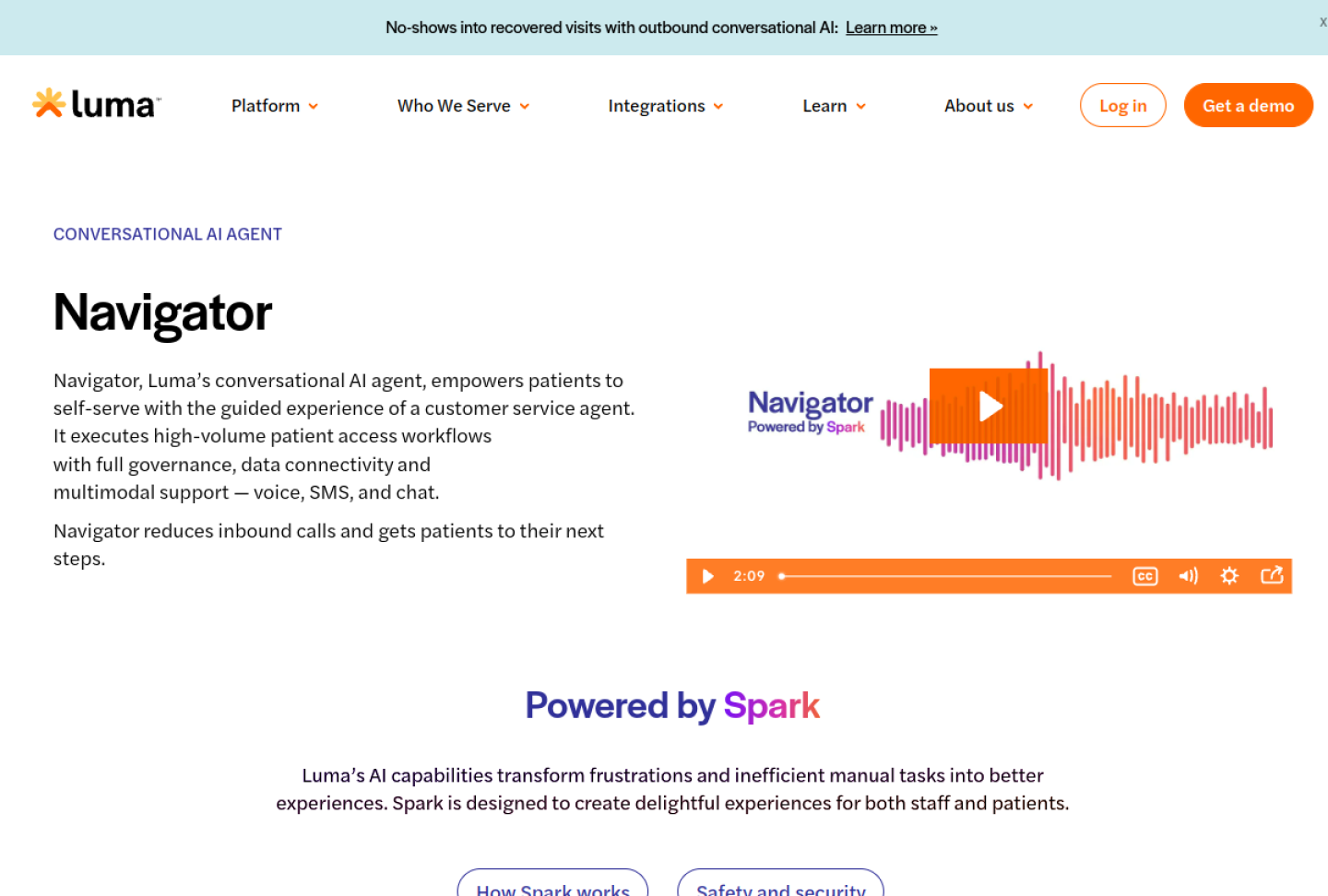
Representative source image: official Luma Health Navigator product page.
Quick answer: Patient scheduling AI can automate appointment booking, reminders, waitlists, referral conversion, intake, and call-center follow-up. It should be evaluated with strict scheduling rules, patient identity checks, EHR or PMS writeback testing, escalation for urgent or unclear requests, PHI controls, staff override, and monitoring for booking errors or access inequity.
Who this guide is for
Patient access leaders, ambulatory operations teams, specialty practices, call centers, digital front door teams, and health-system AI governance committees.
What makes this workflow different
Scheduling AI looks administrative, but wrong-patient bookings, urgent symptoms, referral rules, language access, and failed writeback can still create patient-safety and operational risk.
What to verify before using it
Define which appointment types, specialties, referral paths, eligibility rules, and provider preferences the AI may schedule.
Test identity verification, wrong-patient risk, urgent symptoms, medication requests, complaints, language access, accessibility, and live-staff handoff.
Verify EHR, PMS, CRM, phone, SMS, portal, waitlist, intake, and reminder integrations, including writeback, audit logs, and failure queues.
Review PHI handling, call recordings, transcripts, SMS content, consent, BAA or customer terms, retention, model-training use, and support access.
Monitor booking accuracy, no-shows, abandonment, time to appointment, staff rework, patient complaints, subgroup access, and escalation quality after launch.
Risk level and safe use
Medical risk
Medium
Best first step
Write the workflow in one sentence, decide who reviews the AI output, and test with a small controlled pilot before expanding.
Recommended posture
Use AI as supervised workflow support. Verify sources, privacy, human review, and regulatory fit before relying on outputs.
Source-backed products for this workflow
These profiles are not rankings. They are starting points for checking vendor claims, privacy terms, FDA or regulatory posture, evidence, and workflow fit.
b.well describes bailey as a ready-to-deploy white-label health AI assistant built on its Health AI SDK, grounded in longitudinal health records assembled from clinical, claims, pharmacy, and wearable data; public launch, product, privacy, and terms materials emphasize connected health data, FHIR-oriented workflows, security, and consumer-facing assistant limits that buyers should verify for each deployment.
Best for
Organizations building consumer-facing health navigation, self-service, data access, and follow-through workflows without building their own health AI assistant stack.
First check
Which product is in scope: bailey assistant, Health AI SDK, Large Health Model, connected health platform, SMART on FHIR integration, or a custom app embedding.
Luma describes Navigator as an AI-powered patient self-service solution and Spark as an operational AI core for patient access and staff workflows; public security and policy materials describe healthcare privacy, security controls, AI data boundaries, and policy documentation that still need customer-contract review.
Best for
Healthcare organizations that need governed patient-access automation connected to existing scheduling, communications, and EHR workflows.
First check
Which Luma workflow is in scope: Navigator AI concierge, Spark, Fax Transform, scheduling, waitlist, referrals, intake, payments, eligibility, reminders, or operational AI orchestration.
Clarify describes Meridian as a referral optimization platform for health-system operations that combines AI-driven intelligence with activation infrastructure, including Survey, Plan, and Guide phases. Its Meridian pages describe network intelligence, contract-aware valuation, constraint-aware prioritization, a multi-agent AI engine, physician-level activation playbooks, predictive dashboards, and outcomes-based services. Clarify's June 2026 Loyal acquisition announcement says the combined platform connects referral intelligence with patient activation, real-time scheduling, AI-powered chat, and closed-loop outcomes measurement. Clarify privacy and terms pages describe patient and provider information, health information, HIPAA-governed protected health information handling, customer data ownership, permissions, retention, and audit controls that buyers should verify contractually.
Best for
Health systems trying to reduce referral leakage, route patients to in-network specialists, prioritize service-line growth opportunities, and measure whether referral interventions converted into completed care.
First check
Which capabilities are in scope: Meridian Survey, Plan, Guide, Clarify Atlas data, Loyal Care Activation Platform, scheduling, AI chat, CRM, patient outreach, or Clarify Success Services.
Hippocratic AI presents Polaris-powered healthcare voice agents, says its agents do not diagnose or prescribe, describes more than 1,000 role-specific agents across patient access and clinical operations, lists AI Front Door and Nurse Co-Pilot products, and states that safety testing includes licensed clinicians, output testing, and real-time escalation to human nurses.
Best for
Organizations testing constrained patient engagement, access, post-discharge, remote-monitoring adherence, or inpatient nurse-support conversations with explicit human escalation.
First check
Which agent is in scope: AI Front Door, Polaris Pro, Polaris Flash, Nurse Co-Pilot, post-discharge follow-up, RPM adherence, screening outreach, medication identification, or life-sciences calls.
Sources
5 official sources
Official source trail for this workflow
Open these vendor, documentation, privacy, or regulatory sources before relying on product claims, especially for FDA status, PHI handling, deployment model, and intended use.
Find the best AI for medical workflows by matching the tool to documentation, questions, diagnosis support, research, coding, billing, imaging, or practice operations.
Understand AI for medical diagnosis, including validation evidence, FDA status, clinical supervision, and why patient-specific diagnosis should not rely on general chatbots.