Clinical Decision Support AI: Evaluation Guide
Evaluate clinical decision support AI by intended use, source transparency, workflow fit, privacy, regulatory posture, evidence, and clinician oversight.
Last updated: June 14, 2026
Back to directoryVisual clinical decision support platform with differential diagnosis, evidence-based reference content, a medical image library, and AI-powered dermatology support.
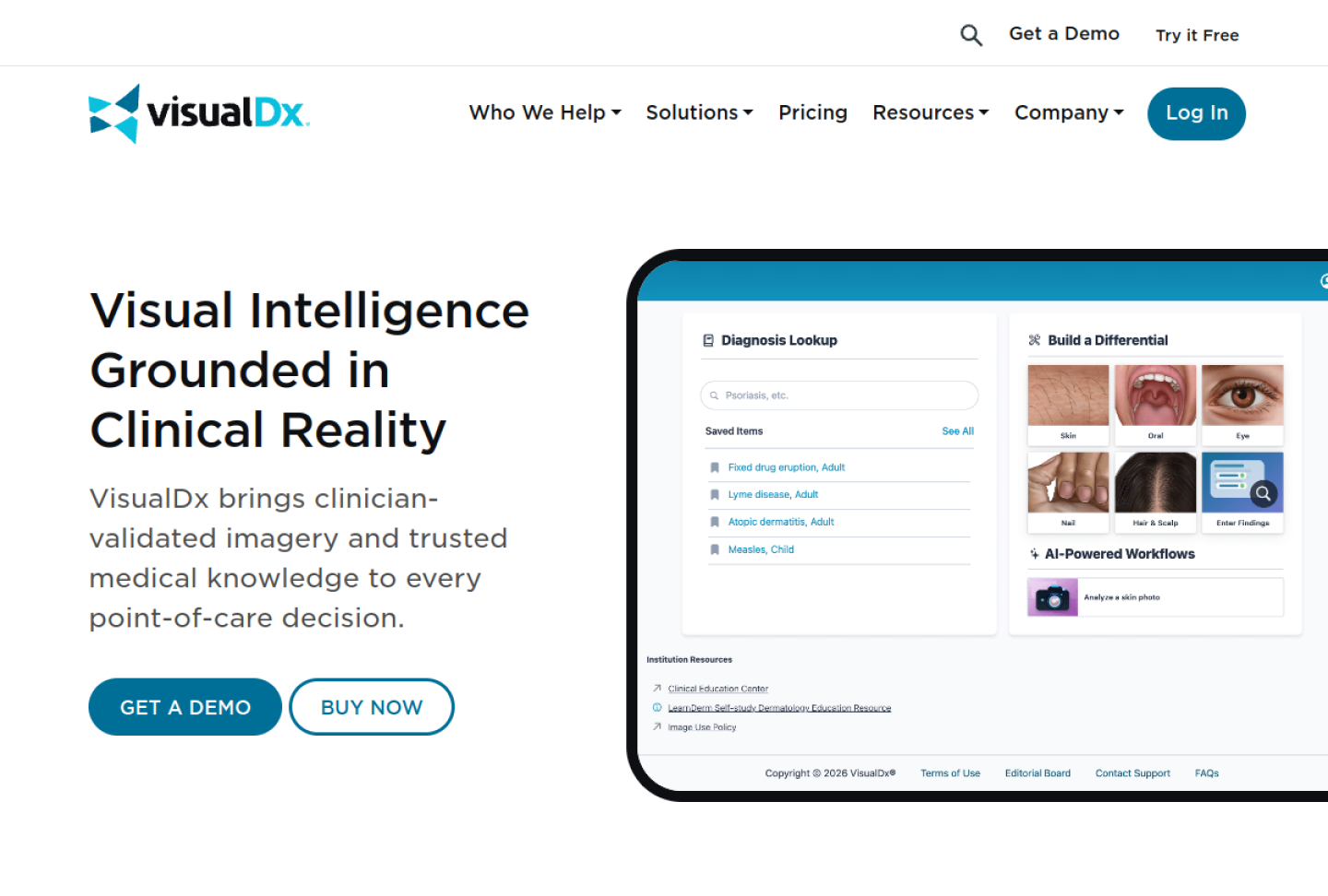
Clinicians and educators who need image-rich differential diagnosis support, skin-of-color representation, patient education visuals, and supervised dermatology decision support.
Compare within workflow: Clinical evidence and questions · comparison shortlist · source index
Current search demand around VisualDx overlaps with visual diagnosis, clinical decision support software, picture diagnosis, dermatology AI, and pricing or login checks. Compare the workflow before treating VisualDx as the right product.
| Compare | When it is relevant | Primary use case |
|---|---|---|
| Isabel DDx Companion | Compare when the main need is differential diagnosis generation from clinical features rather than image-rich dermatology reference. | Differential diagnosis generation, symptom-to-disease matching, EMR-integrated clinical feature extraction, and evidence-linked diagnostic reasoning support |
| Glass Health | Compare when clinicians want AI-assisted differentials and plan drafting with a broader clinical reasoning workflow. | AI-powered clinical decision support, ambient scribing, real-time encounter insights, differential diagnosis drafts, assessment and plan drafts, evidence-backed answers, documentation generation, and developer API workflows |
| UpToDate Expert AI | Compare when the buying criterion is evidence-backed answer retrieval from a widely used clinical reference base. | Conversational clinical question answering grounded in UpToDate content, assumptions, source links, and clinician review |
| DermaSensor | Compare only for clinician-used skin lesion assessment where regulated device status and lesion workflow matter more than reference content. | AI-assisted optical spectroscopy for adjunctive skin cancer risk assessment and dermatologist referral decisions |
Open the VisualDx comparison cluster
Use these workflow guides before evaluating VisualDx against other products, especially when the search intent is broader than the vendor name.
Evaluate clinical decision support AI by intended use, source transparency, workflow fit, privacy, regulatory posture, evidence, and clinician oversight.
Understand AI for medical diagnosis, including validation evidence, FDA status, clinical supervision, and why patient-specific diagnosis should not rely on general chatbots.
Evaluate dermatology AI tools by intended use, FDA or CE status, image workflow, privacy, skin tone evidence, clinician review, and escalation.
Compare AI tools for medical questions by source visibility, recency, hallucination controls, medical disclaimers, and clinician review.
Separate diagnosis search, differential support, image library use, DermExpert, API access, and education workflows because each has different privacy, evidence, and review requirements.
Compare VisualDx with differential diagnosis tools, evidence-answer tools, and dermatology imaging products based on source visibility, image workflow, skin-tone evidence, PHI handling, and clinician review.
Confirm individual, team, institutional, mobile, AI image-analysis, API, privacy, and enterprise agreement terms directly with the vendor before deployment.
Product-specific review. These product-specific signals summarize what the cited sources imply before treating VisualDx as safe for a local clinical, operational, or research workflow.
| Regulatory / FDA | Treat as clinician-reviewed clinical decision support and dermatology image-analysis support; confirm whether the selected function is non-device CDS, educational reference, or a regulated workflow in the deployment jurisdiction. |
|---|---|
| Privacy | Review institutional privacy and security terms before uploading patient photos or using mobile image analysis, including consent, retention, account access, API use, and whether an enterprise agreement or BAA is required. |
| Evidence | Validate performance and usability with local clinicians across skin tones, ages, body locations, common mimics, rare diagnoses, and referral thresholds rather than relying on image-search convenience alone. |
| Workflow | Best governed as supervised differential support with clinician confirmation, source review, documentation outside the tool, escalation rules for dangerous rashes, and clear patient-education boundaries. |
VisualDx describes a visual clinical decision support system for diagnosis search, differential diagnosis, medical images, patient-centered explanations, API use, and DermExpert AI support; public pricing and legal materials describe subscription access, mobile requirements, image-analysis availability, and privacy terms.
Not for: Autonomous diagnosis, patient self-triage without clinician review, emergency decisions, or using image analysis as a substitute for examination, biopsy, specialist review, or clinical judgment.
Use these links to confirm current claims, terms, regulatory status, pricing, and deployment requirements.
Machine-learning differential diagnosis tool that turns presenting clinical features into a clinician-reviewed list of possible diagnoses with evidence reference links.
Agentic AI platform for life-sciences research that combines biomedical evidence retrieval, knowledge graphs, and governed scientific workflow automation.
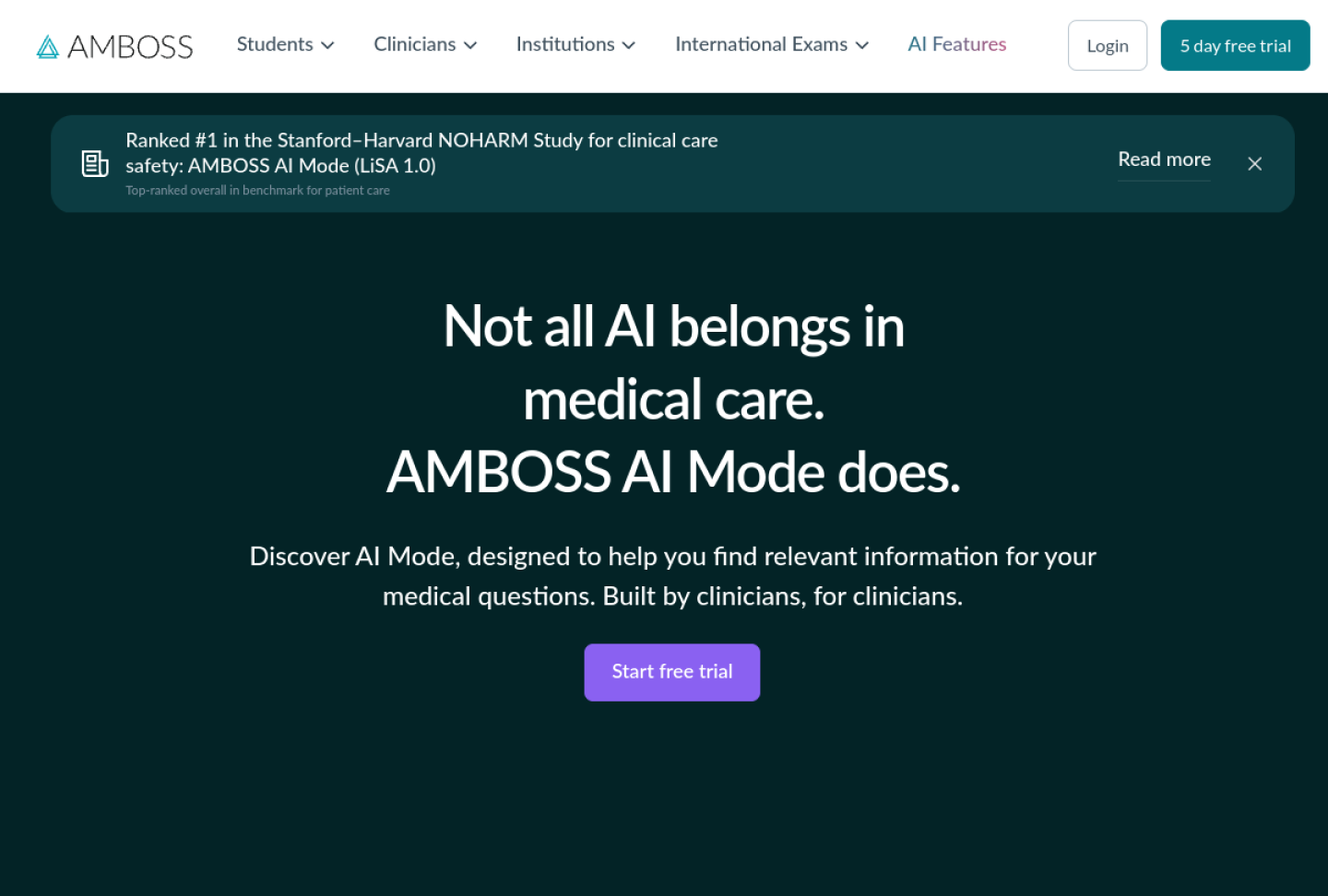
AMBOSS AI Mode adds clinician-designed AI search and study-copilot workflows on top of the AMBOSS medical knowledge and learning platform.

Clinical intelligence platform for NPI-verified clinicians that answers clinical questions with verified citations from indexed medical literature.