Evaluate radiation oncology AI tools by auto-contouring scope, FDA status, CT or MR workflow, privacy, commissioning evidence, and human review.
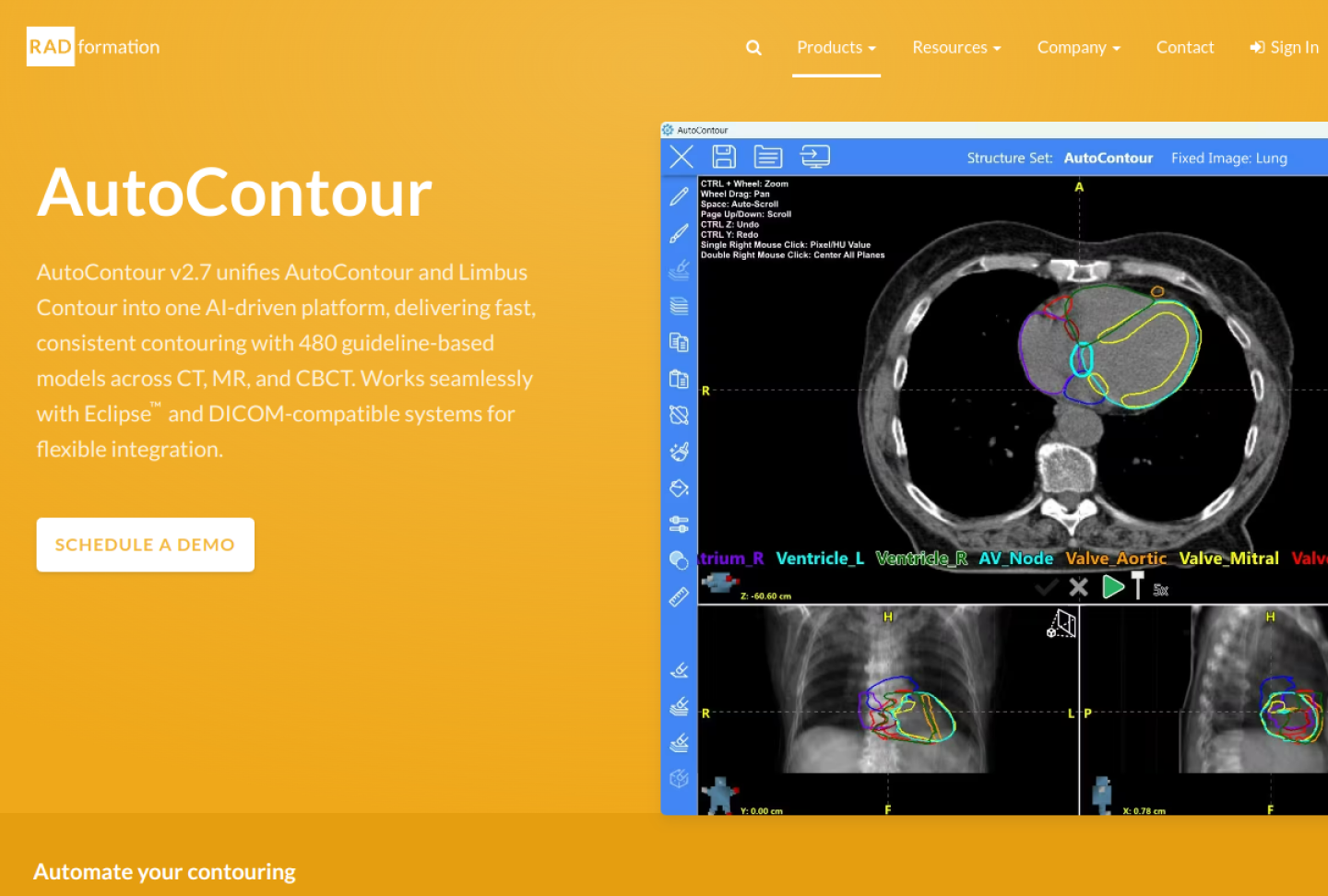
Representative source image: official Radformation AutoContour product page.
Quick answer: Radiation oncology AI tools should be evaluated by the exact workflow: organ-at-risk auto-contouring, target support, adaptive planning, image registration, treatment-plan QA, or procedural guidance. Verify regulatory status, modality and anatomy scope, DICOM and treatment-planning integration, PHI handling, local commissioning results, edit burden, and physician or physicist review before using outputs in patient care.
Who this guide is for
Radiation oncologists, dosimetrists, medical physicists, oncology service-line leaders, treatment-planning teams, and health-system AI governance committees.
What makes this workflow different
Radiation oncology AI can affect simulation, contouring, dose planning, image guidance, and plan review, so buyers need commissioning evidence and explicit specialist review before clinical reliance.
What to verify before using it
Separate organ-at-risk contours, target delineation support, adaptive planning, image registration, plan QA, and intraoperative guidance because each workflow carries different risk.
Verify FDA 510(k), CE, local authorization, research-only status, software version, supported modality, anatomy, and intended use before clinical deployment.
Map CT, MR, CBCT, DICOM, structure-set, treatment-planning, cloud, support-access, retention, audit-log, and BAA or DPA data flows.
Commission performance by disease site, scanner protocol, image quality, artifacts, abnormal anatomy, contour edit burden, plan-quality effects, and clinician acceptance.
Define radiation oncologist, dosimetrist, physicist, or surgeon review, fallback workflow, exception handling, and post-deployment monitoring before acting on AI-generated structures or guidance.
Risk level and safe use
Medical risk
High
Best first step
Write the workflow in one sentence, decide who reviews the AI output, and test with a small controlled pilot before expanding.
Recommended posture
Use AI as supervised workflow support. Verify sources, privacy, human review, and regulatory fit before relying on outputs.
Source-backed products for this workflow
These profiles are not rankings. They are starting points for checking vendor claims, privacy terms, FDA or regulatory posture, evidence, and workflow fit.
Radformation describes AutoContour as AI-driven deep-learning contouring software for radiation oncology, with hundreds of CT, MR, and CBCT structure models, DICOM-compatible workflows, Eclipse integration, and guideline-aligned naming; FDA records and Radformation materials should be checked for the exact cleared version and region.
Best for
Radiation oncology programs that need faster organ-at-risk contouring and can commission, review, edit, and monitor AI-generated structures before planning.
First check
Current FDA 510(k), local regulatory status, AutoContour version, supported CT/MR/CBCT inputs, structure library, and whether Limbus-derived features are included.
MVision describes Contour+ as AI-powered radiotherapy auto-segmentation for organs-at-risk and lymph-node areas, delivered through Workspace+ and GBS workflows; FDA summaries for Contour+ state that CT and MR contours are initial templates that qualified professionals must visualize, review, modify, and approve before clinical use.
Best for
Radiation oncology programs that want guideline-based segmentation coverage across major anatomical sites and can commission local clinician-review workflows.
First check
Current FDA 510(k), CE or local regulatory status, Contour+ version, supported CT and MR models, structure library, and geography.
TheraPanacea describes Annotate as an AI-driven ART-Plan contouring solution for whole-body organs-at-risk and lymph nodes, with batch automation, cloud-based workflow, consensus-guideline alignment, and ongoing model evaluation; buyers should verify module-specific FDA or CE status and local deployment terms.
Best for
Cancer centers evaluating broad whole-body contouring support and cloud-based radiotherapy workflow acceleration with formal clinician validation.
First check
Current FDA, CE, local regulatory status, ART-Plan module name, supported OAR, CTV, lymph-node, TumorBox, and modality scope.
Mirada describes DLCExpert as deep-learning software for CT organ-at-risk autocontouring in radiation oncology, with zero-click workflow support and configurable structure libraries; Mirada materials and NHS AI Award notes emphasize clinical validation and clinician confidence-building for adoption.
Best for
Radiotherapy teams that want configurable AI contouring across head and neck, thorax, breast, prostate, and other OAR workflows with formal quality review.
First check
Current FDA, CE, UK, or local regulatory status, DLCExpert version, Workflow Box or RTx configuration, anatomy coverage, and modality scope.
Sources
4 official sources
Official source trail for this workflow
Open these vendor, documentation, privacy, or regulatory sources before relying on product claims, especially for FDA status, PHI handling, deployment model, and intended use.
Find the best AI for medical workflows by matching the tool to documentation, questions, diagnosis support, research, coding, billing, imaging, or practice operations.
Understand AI for medical diagnosis, including validation evidence, FDA status, clinical supervision, and why patient-specific diagnosis should not rely on general chatbots.