Best AI for Medical Students: Study Tools With Boundaries
Compare AI for medical students by source quality, exam prep fit, citations, assignments policy, and safe study use.
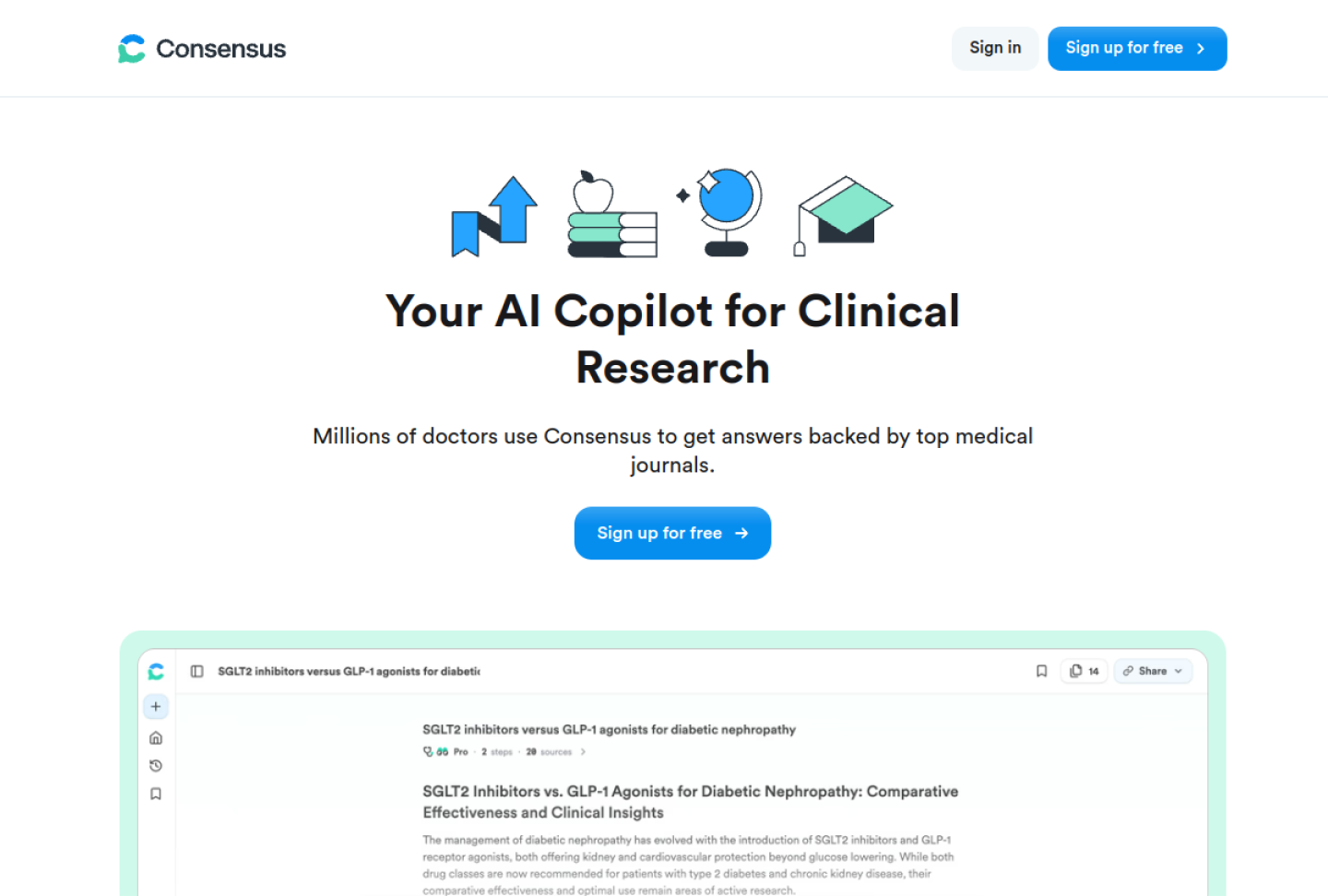
Representative source image: official Consensus product page.
Quick answer: The best AI for medical students helps explain concepts, generate study questions, summarize source material, and organize revision plans. Students should verify facts with curriculum materials and follow school policies for assignments and exams.
Who this guide is for
Medical students, educators, and program administrators.
What makes this workflow different
Supports student study use while warning against unsupported clinical or academic misuse.
What to verify before using it
Check school policy before using AI on assignments.
Use source-backed tools for medical facts.
Ask for explanations, quizzes, and spaced review plans rather than patient advice.
Verify citations and guideline dates.
Do not submit unreviewed AI-generated work as original analysis.
Risk level and safe use
Medical risk
Low to medium
Best first step
Write the workflow in one sentence, decide who reviews the AI output, and test with a small controlled pilot before expanding.
Recommended posture
Use AI as supervised workflow support. Verify sources, privacy, human review, and regulatory fit before relying on outputs.
Source-backed products for this workflow
These profiles are not rankings. They are starting points for checking vendor claims, privacy terms, FDA or regulatory posture, evidence, and workflow fit.
AMBOSS describes AI Mode as a clinician-designed AI search agent for clinical care that connects natural-language questions to verified AMBOSS medical knowledge and selected external sources; AMBOSS also describes AI Mode Learning as a study copilot inside its education platform, and its privacy policy covers personal-data processing for the AMBOSS website, registered program, apps, and institutional licenses.
Best for
Clinicians or learners who already trust AMBOSS content and want AI-assisted search that routes them back to curated medical knowledge and traceable sources.
First check
Which workflow is enabled: clinical AI Mode, AI Mode Learning, LiSA, semantic search, AMBOSS GPT, or another institutional AI feature.
Trip Database describes AskTrip as an AI-powered tool for clinicians to explore high-quality evidence in response to clinical questions. Trip's main site says the database gives access to clinical articles, systematic reviews, and medical guidelines. Buyers should treat AskTrip as evidence navigation, not autonomous clinical advice, and verify source coverage, answer traceability, privacy, and current Pro limits before relying on it in workflow.
Best for
Clinicians and education teams that want a quick evidence-search companion with source links before reading full guidelines, reviews, or primary studies.
First check
Whether AskTrip is being used for background evidence lookup, point-of-care reference, teaching, guideline surveillance, or patient-specific decision support.
Consensus presents a medical research feature for clinical research and source-backed study snapshots, and its help materials explain source data and AI features such as study summaries and paper-level analysis.
Best for
Literature discovery and source-backed medical research exploration.
OpenEvidence describes itself as a medical information platform with JAMA and NEJM content agreements and clinician-focused evidence synthesis; its privacy materials describe HIPAA-aligned processing and state that AI models are not trained on PHI.
Best for
Clinicians who need fast answers grounded in medical literature and source partnerships.
First check
Whether your user type and region are eligible.
Sources
3 official sources
Official source trail for this workflow
Open these vendor, documentation, privacy, or regulatory sources before relying on product claims, especially for FDA status, PHI handling, deployment model, and intended use.
Find the best AI for medical workflows by matching the tool to documentation, questions, diagnosis support, research, coding, billing, imaging, or practice operations.
Understand AI for medical diagnosis, including validation evidence, FDA status, clinical supervision, and why patient-specific diagnosis should not rely on general chatbots.